How to Practice Skills Effectively
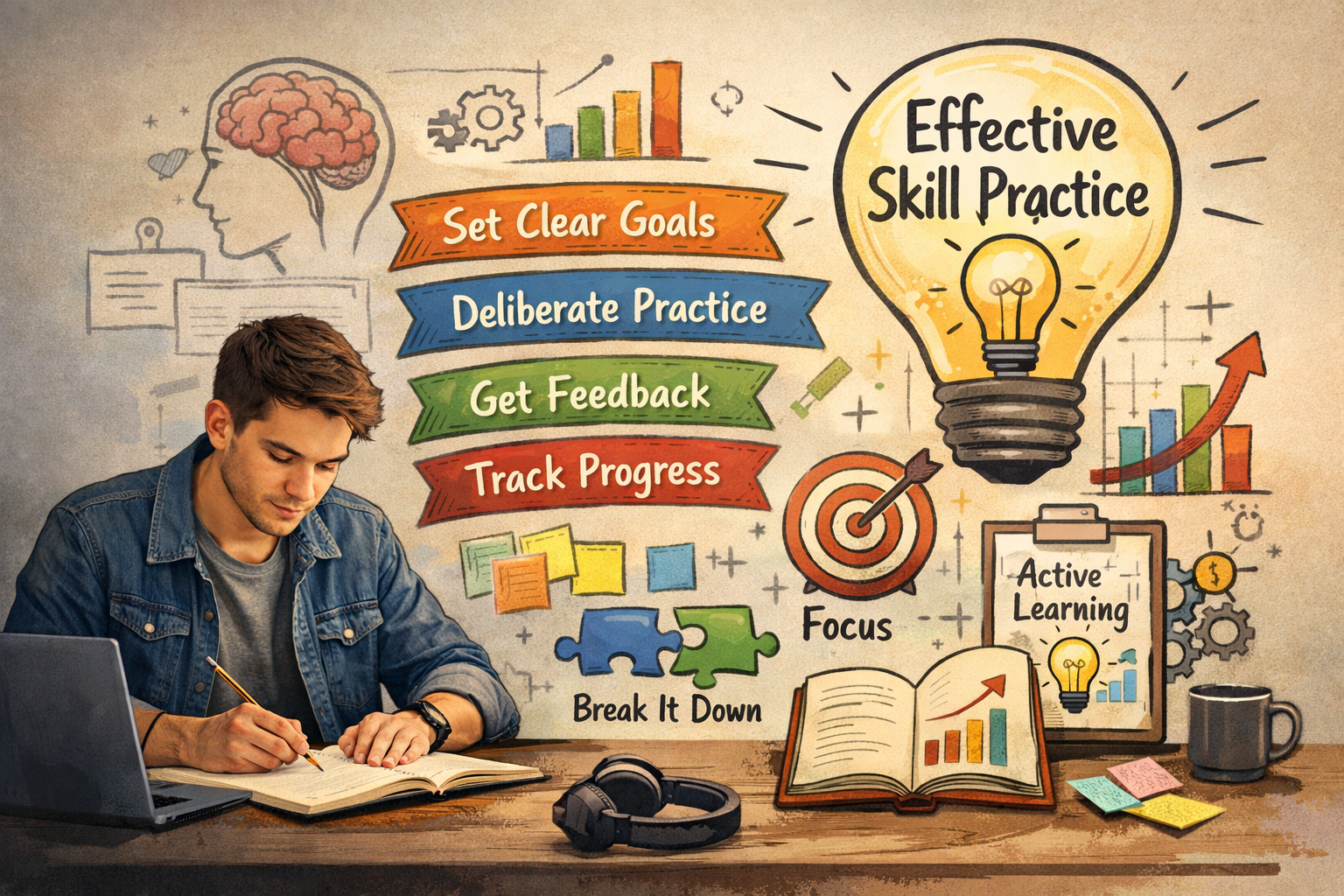
Learning a new skill is exciting at first. Whether it’s writing, coding, playing an instrument, or mastering a professional ability, the early stages often bring motivation and curiosity. However, many people struggle after the initial enthusiasm fades. They continue practicing but see little improvement, which leads to frustration.
The truth is that practicing alone is not enough. The way you practice determines how quickly and effectively you improve. Many learners spend hours repeating tasks without a clear strategy, while others progress rapidly because they follow proven learning principles.
In this guide, we will explore how to practice skills effectively so that your effort leads to real progress. By understanding structured practice methods, feedback loops, and cognitive learning strategies, you can dramatically accelerate your growth.
Understanding the Difference Between Practice and Effective Practice
Most people assume that repeating an activity automatically leads to mastery. While repetition does help reinforce neural pathways, it only produces significant results when combined with deliberate strategies.
Effective practice involves:
- Clear learning goals
- Immediate feedback
- Focus on weaknesses
- Structured repetition
- Reflection and adjustment
Without these components, practice can become mindless repetition.
For example, someone learning guitar might spend hours playing songs they already know. While enjoyable, this doesn’t necessarily improve their skill level. A more effective approach would be identifying difficult chord transitions and practicing them intentionally.
This concept is often referred to as deliberate practice, a method widely used by elite performers, athletes, and professionals.
The Science Behind Skill Development
Skill acquisition is deeply connected to how the brain forms neural connections. Every time you practice a task, the brain strengthens specific neural pathways associated with that activity.
However, these pathways only improve when the brain is challenged.
If a task is too easy, the brain goes on autopilot and learning slows down. If it is too difficult, frustration can prevent progress. The most effective practice happens in the optimal challenge zone, where the activity is slightly beyond your current ability.
This balance allows your brain to adapt and grow more efficiently.
Additionally, studies in cognitive science show that structured learning systems significantly accelerate skill acquisition. People who study frameworks like How to Learn New Skills Quickly often discover that improvement is not about talent but about using the right learning methods.
Setting Clear Practice Goals
One of the biggest mistakes learners make is practicing without a clear objective.
Instead of saying:
“I will practice drawing for an hour.”
A better goal would be:
“I will practice drawing human hands from reference images for 45 minutes.”
Specific goals create measurable progress.
Why Specific Goals Matter
Clear goals help you:
- Focus on a single skill component
- Track improvement over time
- Identify weaknesses more easily
- Avoid wasted effort
When your practice session has a defined outcome, every minute becomes more productive.
Breaking Skills into Smaller Components
Complex skills are made up of many smaller abilities. Trying to improve everything at once often leads to slow progress.
The most effective learners break skills into manageable parts.
Example: Learning Public Speaking
Instead of practicing “public speaking” as one large skill, you could focus on:
- Voice projection
- Body language
- Storytelling structure
- Audience engagement
- Confidence under pressure
By isolating individual components, you can improve faster and with greater precision.
This approach is commonly used in professional training programs and elite coaching environments.
The Role of Active Learning
Passive learning methods—like watching tutorials or reading guides—can provide valuable information, but they rarely build real skills on their own.
Skill mastery requires active participation.
Effective learners use strategies similar to Active Learning Techniques That Work, which emphasize engagement, experimentation, and feedback rather than passive observation.
Active learning may include:
- Practicing immediately after learning a concept
- Teaching the concept to someone else
- Testing yourself without notes
- Applying knowledge to real-world problems
When learners actively interact with the material, the brain processes information more deeply, leading to stronger retention and faster improvement.
Using Deliberate Practice
Deliberate practice is widely recognized as one of the most effective ways to build expertise.
Unlike casual practice, deliberate practice focuses specifically on improving performance.
Key Principles of Deliberate Practice
- Focus on weaknesses
Identify the areas where you struggle the most. - Work on one skill at a time
Target a specific improvement during each session. - Use immediate feedback
Feedback helps correct mistakes before they become habits. - Practice with full concentration
Short, focused sessions are often more effective than long, distracted ones. - Repeat difficult sections
Instead of practicing the entire task, repeat the challenging parts.
For example, a writer might focus solely on crafting stronger introductions instead of writing full articles every time.
The Importance of Feedback
Feedback is one of the most powerful tools for skill improvement.
Without feedback, it is difficult to know whether your practice is effective.
Feedback can come from:
- Mentors or coaches
- Peers or colleagues
- Self-assessment
- Digital tools or analytics
For instance, language learners often record themselves speaking and listen back to identify pronunciation errors.
The faster you receive feedback, the faster you can adjust your approach.
Practicing With Intensity and Focus
Many people believe that practicing longer leads to better results. However, research shows that focused practice sessions are far more effective than long, unfocused ones.
High performers typically practice in shorter sessions with intense concentration.
The Ideal Practice Structure
A productive session may look like this:
- Warm-up (5–10 minutes)
Review familiar material. - Focused skill practice (20–40 minutes)
Work on the most challenging element. - Application (15–30 minutes)
Use the skill in a real scenario. - Reflection (5 minutes)
Evaluate what improved and what needs work.
This structure helps maintain focus while maximizing learning efficiency.
Tracking Your Progress
One of the most motivating aspects of learning is seeing measurable improvement.
Tracking your progress helps you stay motivated and refine your learning strategies.
You can track progress through:
- Practice journals
- Performance metrics
- Video or audio recordings
- Skill benchmarks
For example, a programmer might track how quickly they solve coding problems, while a musician might track tempo improvements.
Progress tracking also highlights patterns that help you adjust your training methods.
The Power of Consistency
Consistency often matters more than intensity.
Practicing for 30 minutes every day is usually more effective than practicing for five hours once a week.
Daily practice helps reinforce neural connections and prevents skill decay.
Why Daily Practice Works
Consistent practice:
- Strengthens memory retention
- Maintains momentum
- Prevents forgetting
- Builds discipline
Over time, these small daily improvements compound into significant long-term progress.
Avoiding Burnout While Practicing
While dedication is important, overtraining can reduce motivation and performance.
Signs of burnout include:
- Lack of enthusiasm
- Mental fatigue
- Declining performance
- Frustration with small mistakes
To prevent burnout, balance intense practice with rest and recovery.
Strategies include:
- Taking short breaks during practice
- Rotating different skills
- Celebrating small milestones
- Maintaining realistic expectations
Remember that skill development is a marathon, not a sprint.
Applying Skills in Real-World Situations
Practice becomes truly effective when skills are applied in real situations.
Many learners stay in “practice mode” for too long without testing their abilities in practical scenarios.
Real-world application provides:
- Authentic feedback
- Increased confidence
- Adaptability
- Deeper understanding
For example:
- Writers publish articles
- Programmers build real applications
- Language learners speak with native speakers
- Designers work on actual projects
The more frequently you apply your skills, the faster they become natural and automatic.
Building a Personal Practice System
The most successful learners eventually develop their own practice systems.
A personal system might include:
- Weekly skill goals
- Daily focused practice sessions
- Regular feedback reviews
- Monthly progress evaluations
This structured approach ensures that learning remains intentional rather than random.
Over time, your system evolves as you discover which strategies work best for your learning style.
Final Thoughts
Practicing effectively is not about spending endless hours repeating the same tasks. True improvement comes from practicing with purpose, structure, and awareness.
When you combine deliberate practice, active learning, focused sessions, and consistent feedback, your progress accelerates dramatically. Skills that once seemed difficult become manageable, and challenges transform into opportunities for growth.
By setting clear goals, breaking complex abilities into smaller components, and maintaining consistency, anyone can master new skills more efficiently.
Remember that improvement is rarely instant. The key is practicing intelligently and trusting the process. With the right strategies and persistence, every practice session brings you closer to mastery.