How to Learn New Skills Quickly
In today’s fast-moving world, the ability to learn new skills quickly is more valuable than ever. Whether you want to switch careers, start a business, master a new technology, or improve a personal hobby, learning efficiently can dramatically accelerate your progress.
The good news? Learning faster isn’t about being a genius. It’s about using the right strategies, understanding how your brain works, and applying proven methods consistently.
In this article, you’ll discover practical, science-backed techniques to help you learn new skills quickly and effectively—without burnout or overwhelm.
Why Most People Struggle to Learn New Skills
Before we talk about speed, let’s address the real problem: inefficiency.
Many people:
- Consume too much information and take little action
- Study passively (reading or watching without practice)
- Jump between topics without structure
- Quit too early when results aren’t immediate
Learning is not about collecting information. It’s about building capability.
To learn quickly, you need focus, structure, and deliberate practice.
The Science Behind Learning Faster
Your brain changes through a process called neuroplasticity—the ability to form and reorganize neural connections. Every time you practice a skill, you strengthen specific neural pathways.
Three key principles drive faster learning:
1. Active Engagement
You learn more when you do, not when you passively consume.
2. Spaced Repetition
Spreading practice over time strengthens memory.
3. Immediate Feedback
The faster you know what’s wrong, the faster you improve.
When applied correctly, these principles dramatically shorten the time needed to develop competence.
Step 1: Get Clear on the Exact Skill
“Learning guitar” is vague.
“Learning to play 5 basic chords smoothly” is specific.
Clarity reduces overwhelm.
Ask yourself:
- What exact skill do I want?
- What does beginner competence look like?
- What small sub-skills make it up?
Break the skill into components. For example:
Public Speaking
- Voice control
- Body language
- Structure
- Audience engagement
Small, defined targets accelerate mastery.
Step 2: Use the 80/20 Rule
The Pareto Principle states that 20% of efforts produce 80% of results.
Identify:
- The core techniques that deliver most results
- The most common patterns
- The most frequent real-world applications
For example:
- In language learning: high-frequency vocabulary
- In coding: fundamental logic structures
- In fitness: compound movements
Focus on high-impact fundamentals first.
Step 3: Follow a Structured Learning Framework
Random learning slows you down. Structure speeds you up.
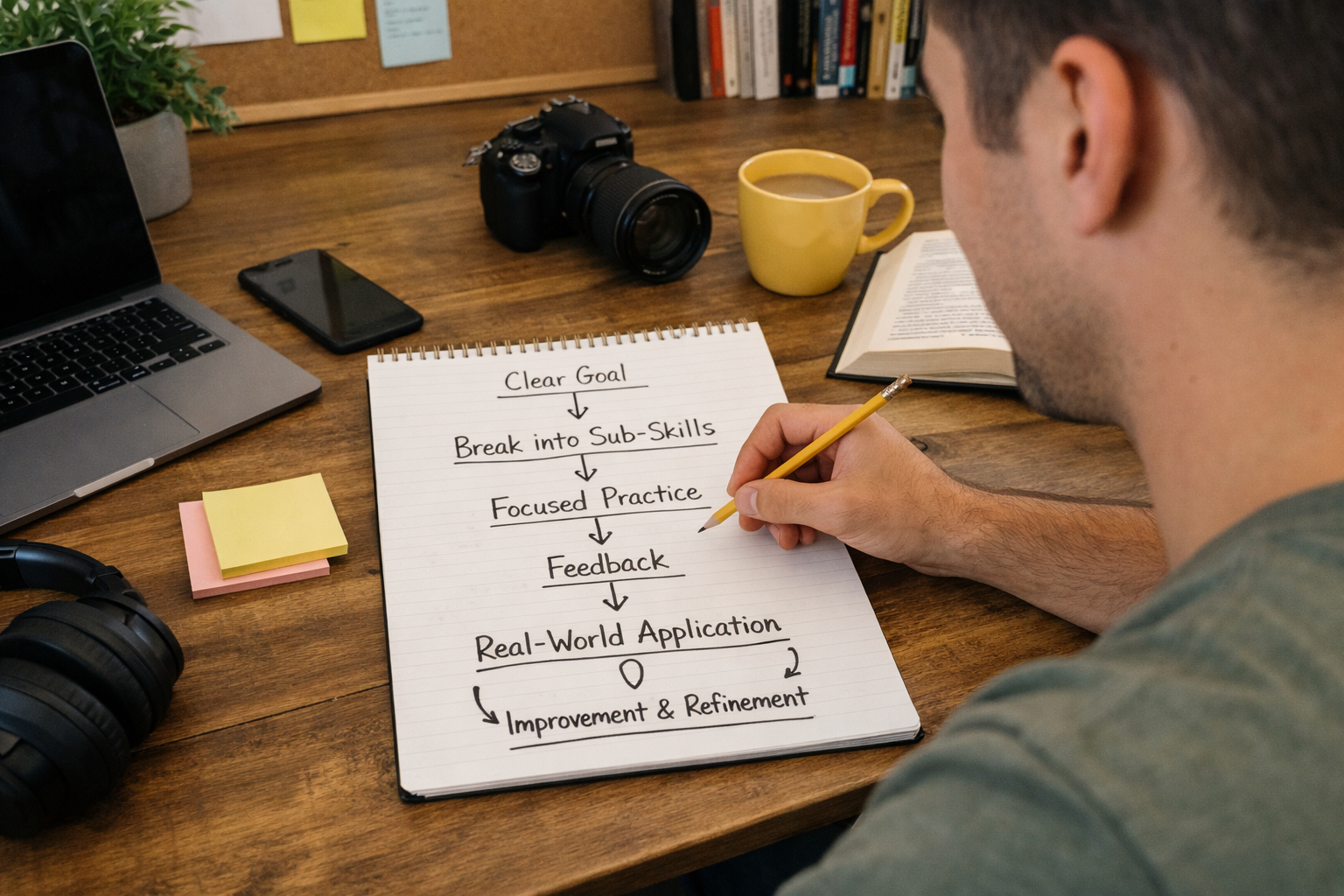
If you want a systematic method, follow a Step-by-Step Guide to Learning Any Skill that includes:
- Define the outcome clearly
- Break the skill into micro-skills
- Focus on one sub-skill at a time
- Practice deliberately
- Seek feedback
- Adjust and repeat
Structure eliminates guesswork and reduces mental friction.
Step 4: Practice Deliberately (Not Repeatedly)
There is a difference between repetition and deliberate practice.
Repetition:
- Doing something again and again
Deliberate practice:
- Identifying weaknesses
- Practicing with full focus
- Targeting errors
- Tracking improvement
For example:
Instead of “playing the whole song again,” isolate the difficult chord transition and practice only that part slowly until smooth.
Short, focused sessions outperform long distracted ones.
Step 5: Learn in Short, Intense Bursts
Your brain has limited deep-focus capacity.
Use:
- 25–45 minute focused sessions
- 5–10 minute breaks
- No multitasking
This method increases retention and prevents mental fatigue.
Quality > quantity.
Step 6: Apply What You Learn Immediately
Knowledge without application fades quickly.
If you:
- Learn writing → publish something
- Learn coding → build a mini project
- Learn marketing → run a small campaign
- Learn design → create real visuals
Real-world application accelerates learning more than theory ever will.
Step 7: Track Progress Visibly
Progress builds motivation.
Use:
- Checklists
- Habit trackers
- Weekly skill logs
- Before/after comparisons
When you see improvement, your brain releases dopamine, reinforcing the learning loop.
Step 8: Optimize Your Environment
Your environment either supports learning or distracts you.
Improve it by:
- Removing phone notifications
- Setting a dedicated learning space
- Preparing materials in advance
- Studying at consistent times
Small environmental changes can dramatically increase focus.
Step 9: Leverage Feedback Loops
Feedback accelerates correction.
Sources of feedback:
- Mentors
- Online communities
- Coaches
- Performance reviews
- Self-recording (video/audio)
If you’re learning alone, record yourself. Review. Improve. Repeat.
Rapid correction = rapid growth.
Step 10: Think Like an Adult Learner
Adults learn differently than children. You bring:
- Prior experience
- Pattern recognition
- Emotional intelligence
- Real-world context
If you want deeper insight into cognitive strategies specifically designed for grown learners, explore How to Learn Faster as an Adult to understand how maturity can become your advantage.
Age is not a limitation. It’s leverage—when used correctly.
Common Mistakes That Slow Down Learning
Avoid these traps:
1. Overconsumption
Watching tutorials for weeks without practice.
2. Perfectionism
Waiting until you feel “ready” before taking action.
3. Comparing Your Chapter 1 to Someone’s Chapter 20
Progress is personal.
4. Lack of Consistency
Small daily effort beats occasional intensity.
The 30-Day Skill Acceleration Plan
If you want practical structure, try this:
Week 1 – Foundation
- Define skill
- Break into sub-skills
- Study core concepts
- Begin light practice
Week 2 – Focused Practice
- Daily deliberate practice
- Track mistakes
- Refine technique
Week 3 – Application
- Apply in real situations
- Build a small project
- Seek feedback
Week 4 – Optimization
- Identify weak spots
- Increase difficulty
- Measure improvement
Thirty days of focused effort can create visible transformation.
The Mindset Shift That Changes Everything
Speed is not about rushing.
It’s about:
- Reducing wasted effort
- Targeting the right fundamentals
- Practicing intentionally
- Applying immediately
The fastest learners are not the most talented.
They are the most structured.
Final Thoughts
Learning new skills quickly is not a secret reserved for gifted individuals. It is a process that can be engineered.
When you:
- Define clearly
- Focus on fundamentals
- Practice deliberately
- Seek feedback
- Apply consistently
You dramatically shorten the learning curve.
The ability to learn quickly is itself a skill. And once you master it, every future skill becomes easier to acquire.
Start small. Stay consistent. Improve daily.
That’s how real acceleration happens.