How Adult Brains Actually Learn
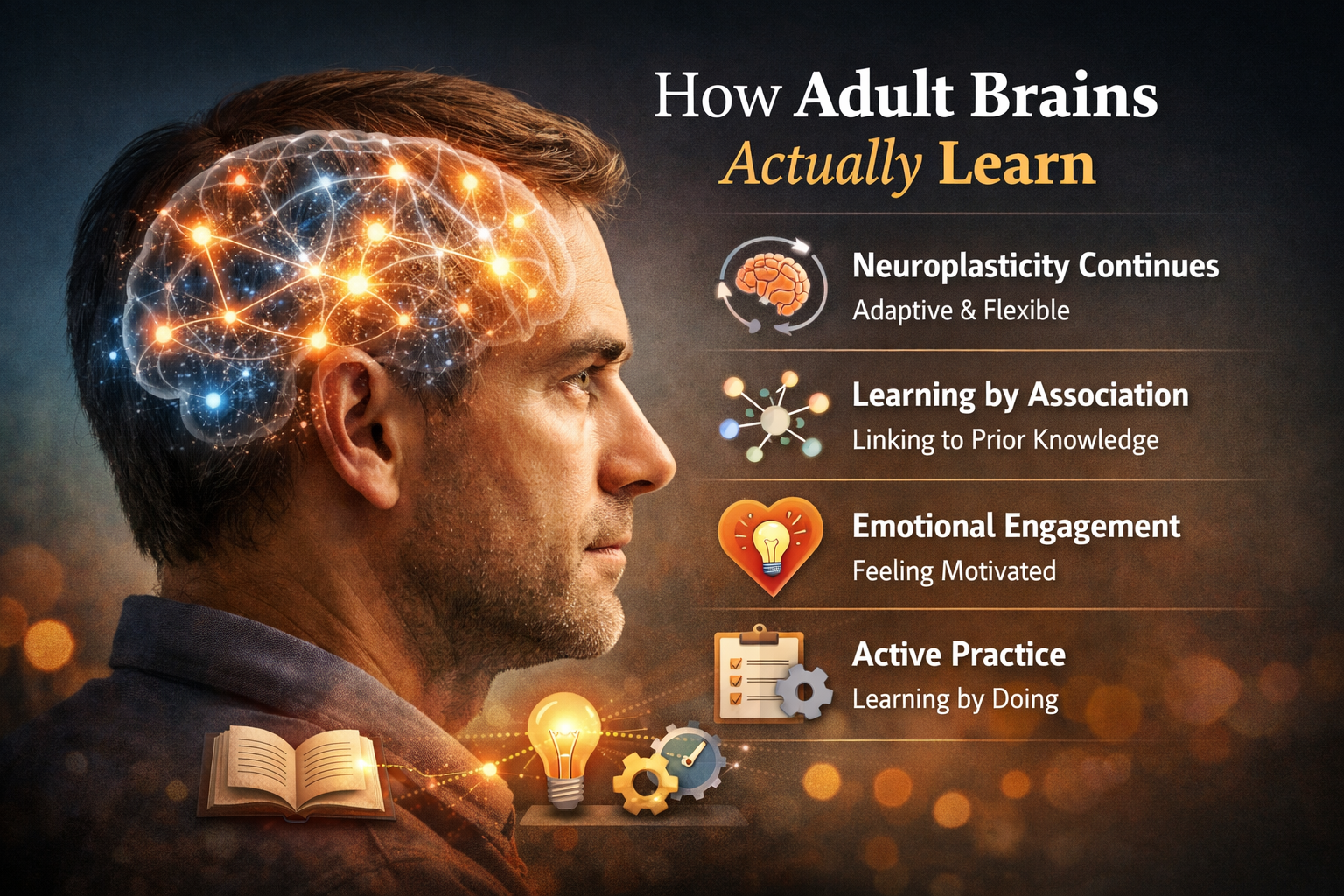
For many people, adulthood comes with an uncomfortable belief: learning is for the young. Busy schedules, family responsibilities, and years away from formal education often make adults feel that their brains are no longer suited for deep learning. Yet modern neuroscience tells a very different story. Adult brains do not stop learning—they simply learn differently.
Understanding how adult brains actually learn is the key to studying more effectively, remembering information longer, and applying new skills in real life. This article explores what really happens inside the adult brain, why learning feels harder with age, and how adults can turn their experience into a powerful advantage.
The Myth That Adult Brains Can’t Learn
One of the biggest misconceptions about adult learning is that the brain becomes rigid after childhood. While it is true that children’s brains are highly flexible, adult brains are far from static. The idea that “you can’t teach an old dog new tricks” is not supported by science.
Adults continue to form new neural connections throughout their lives. What changes is not the ability to learn, but the mechanism by which learning occurs. Adults rely more on existing knowledge, emotional relevance, and purposeful practice rather than passive repetition.
In other words, adult brains are not weaker—just more selective.
Neuroplasticity Doesn’t Disappear With Age
Neuroplasticity is the brain’s ability to reorganize itself by forming new neural pathways. For a long time, scientists believed neuroplasticity was limited to childhood. Today, research clearly shows that adult brains remain plastic well into old age.
However, adult neuroplasticity works best under certain conditions:
- Repetition with meaning
- Emotional engagement
- Real-world application
- Focused attention
When learning feels relevant and useful, adult brains adapt more efficiently than many people expect.
Why Learning Feels Harder as an Adult
If adult brains can still learn, why does it often feel more difficult?
Cognitive Load Is Higher
Adults juggle more responsibilities—work, finances, relationships, and stress. This increases cognitive load, making it harder to focus deeply on new information.
Fear of Failure Increases
Children experiment freely. Adults often fear looking incompetent or making mistakes. This anxiety activates stress responses that interfere with memory formation and problem-solving.
Passive Learning No Longer Works
Methods that worked in school—highlighting text or rereading notes—are far less effective for adult learners. Without active engagement, information simply doesn’t stick.
How Adult Brains Actually Encode Information
Adult learning relies heavily on connection rather than memorization.
Learning Through Association
Adults understand new ideas by linking them to what they already know. The richer your prior knowledge, the easier it becomes to absorb complex concepts.
Learning Through Meaning
Adult brains prioritize information that has a clear purpose. If you don’t see why something matters, your brain is less likely to store it.
Learning Through Emotion
Emotion plays a major role in memory. Content tied to personal goals, challenges, or curiosity is remembered far more easily than neutral facts.
The Role of Experience in Adult Learning
Experience is often seen as a disadvantage when learning something new, but it is actually one of the adult brain’s greatest strengths.
Adults:
- Recognize patterns faster
- Make deeper judgments
- Transfer knowledge across domains
- Understand context and nuance
This is why adults excel at problem-based learning and real-world application, even if they struggle with rote memorization.
Active Learning Is Non-Negotiable for Adults
Adult brains learn best through action, not consumption.
Effective strategies include:
- Teaching what you learn to someone else
- Practicing retrieval instead of rereading
- Applying concepts to real situations
- Asking “how” and “why” questions
If you want a deeper understanding of why these methods work, exploring The Science of Effective Learning can help explain the neurological processes behind active learning.
Motivation Changes How the Adult Brain Learns
Unlike children, adults are rarely forced to learn. Motivation becomes the engine of progress.
There are two main types of motivation:
- Extrinsic: learning for rewards, promotions, or credentials
- Intrinsic: learning out of curiosity, purpose, or personal growth
Adult brains respond more strongly to intrinsic motivation. When learning aligns with identity or long-term goals, focus and retention improve dramatically.
The Importance of a Growth-Oriented Perspective
One of the most powerful factors in adult learning is mindset.
Adults who believe intelligence is fixed tend to:
- Avoid challenges
- Give up quickly
- Interpret struggle as failure
Those who see learning as a process embrace effort and mistakes as part of growth. Developing a Growth Mindset for Adult Learners allows the brain to stay open, adaptive, and resilient in the face of difficulty.
Sleep, Stress, and Adult Learning
Biology matters more than most people realize.
Sleep Consolidates Memory
New information is strengthened during sleep. Chronic sleep deprivation significantly reduces learning efficiency, no matter how good your study methods are.
Stress Blocks Learning
High stress triggers cortisol, which interferes with memory formation. Calm focus is far more effective than anxious overwork.
Adults who manage sleep and stress consistently outperform those who rely on long study hours alone.
Learning Speed vs. Learning Depth
Adults may feel slower than younger learners, but speed is not the goal.
Adult brains:
- Learn more deeply
- Retain information longer
- Apply knowledge more strategically
Once adults use methods aligned with how their brains work, they often discover that learning becomes more efficient over time. If improving efficiency is your goal, understanding How to Learn Faster as an Adult can provide practical frameworks that fit adult cognitive patterns.
Turning Adult Learning Into a Strength
The adult brain is not broken, outdated, or incapable. It is refined, selective, and purpose-driven. When adults stop trying to learn like children and start learning like adults, everything changes.
By leveraging experience, focusing on meaning, practicing actively, and maintaining the right mindset, adult learners can master new skills, adapt to changing environments, and continue growing at any stage of life.
Learning doesn’t end with age—it evolves.