How to Learn Difficult Topics Easily
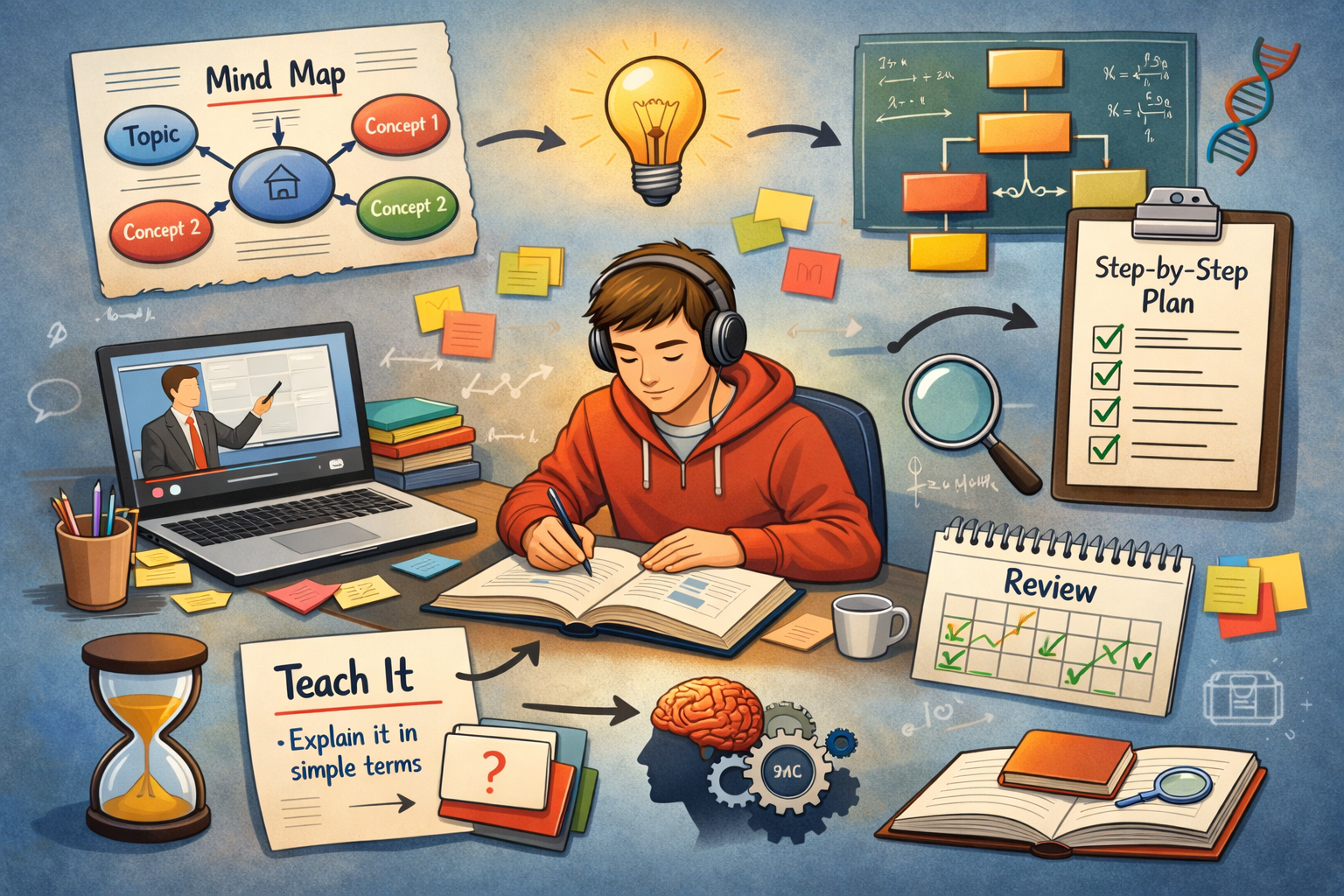
Learning difficult topics can feel overwhelming. Whether you’re studying advanced mathematics, mastering a new programming language, or trying to understand complex theories, the challenge often lies not in intelligence but in strategy. Many people struggle because they approach difficult subjects using ineffective methods that lead to frustration, confusion, and eventually burnout.
The good news is that difficult topics can become manageable when you use the right learning techniques. By breaking complex ideas into smaller parts, using structured learning methods, and practicing actively, anyone can make progress—even in subjects that once seemed impossible to understand.
In this article, we will explore practical strategies that make learning complex material easier, faster, and more enjoyable.
Why Difficult Topics Feel Hard to Learn
Before learning how to tackle difficult subjects, it’s important to understand why they feel difficult in the first place.
1. Cognitive Overload
Many complex topics contain a large number of new concepts. When too much information is presented at once, the brain becomes overloaded and struggles to process everything effectively.
For example, when learning physics or coding, beginners often face multiple unfamiliar ideas at the same time. Without a structured approach, this leads to confusion.
2. Lack of Foundational Knowledge
Difficult subjects often build upon previous knowledge. If foundational concepts are weak, advanced ideas become much harder to grasp.
For instance, learning calculus without strong algebra skills will feel extremely difficult.
3. Passive Learning Habits
Many learners rely on passive methods like rereading notes or watching videos repeatedly. While these methods feel productive, they rarely lead to deep understanding.
Active engagement is required to truly master challenging material.
Change Your Mindset About Difficult Topics
The first step in learning difficult subjects is adjusting your mindset.
Instead of seeing complexity as a barrier, view it as a process of gradual understanding. Every expert once struggled with the basics.
Developing a growth-oriented perspective helps learners stay motivated when progress feels slow. This concept is often emphasized in learning frameworks such as How to Learn Faster as an Adult, which highlights the importance of persistence and adaptive learning strategies.
When you believe improvement is possible, your brain becomes more willing to explore new ideas and persist through challenges.
Break Complex Topics Into Smaller Pieces
One of the most powerful learning strategies is called chunking.
What Is Chunking?
Chunking means dividing large amounts of information into smaller, manageable sections.
Instead of trying to understand an entire chapter at once, break it down into smaller concepts.
For example:
Complex Topic: Machine Learning
Breakdown:
- What is machine learning?
- Types of machine learning
- Training data
- Algorithms
- Model evaluation
By focusing on one piece at a time, the subject becomes less intimidating.
Why Chunking Works
The human brain processes information better when it is grouped logically. Smaller units are easier to understand and remember.
Over time, these small pieces connect together to form a complete understanding of the topic.
Use the Feynman Technique
The Feynman Technique is one of the most effective methods for learning difficult subjects.
Step 1: Learn the Concept
Start by studying a concept through books, videos, or lectures.
Step 2: Explain It Simply
Try explaining the concept as if you were teaching a beginner or a child.
Use simple language.
If you cannot explain it clearly, that means you don’t fully understand it yet.
Step 3: Identify Knowledge Gaps
When explaining, you’ll notice areas where your understanding is incomplete.
Return to the source material and review those parts.
Step 4: Simplify Again
Refine your explanation until it becomes clear and concise.
Teaching—even if only to yourself—is one of the best ways to learn.
Use Visual Learning
Visual representations can simplify complex ideas dramatically.
Diagrams and Mind Maps
Mind maps help connect concepts visually.
For example, a mind map for biology might include:
- Cells
- DNA
- Organ systems
- Evolution
Seeing relationships between ideas makes learning easier.
Flowcharts
Flowcharts are especially helpful in subjects like programming or mathematics where processes matter.
They allow learners to follow step-by-step logic visually.
Practice Active Recall
Active recall is one of the most powerful learning strategies supported by cognitive science.
Instead of reviewing information passively, force your brain to retrieve it.
Examples include:
- Answering practice questions
- Explaining concepts from memory
- Writing summaries without notes
- Using flashcards
Every time you recall information, your memory strengthens.
Use Spaced Repetition
Spaced repetition improves long-term retention by reviewing information at increasing intervals.
Instead of studying a topic once, revisit it multiple times:
- Day 1: Initial learning
- Day 2: Review
- Day 5: Review again
- Day 10: Another review
This technique prevents forgetting and strengthens memory connections.
Follow a Structured Learning System
Learning difficult topics becomes easier when you follow a structured approach.
Many successful learners rely on frameworks similar to a Step-by-Step Guide to Learning Any Skill, which organizes the learning process into clear stages.
These stages often include:
- Understanding the fundamentals
- Practicing core concepts
- Applying knowledge through projects
- Reviewing mistakes
- Reinforcing knowledge through repetition
A structured system reduces confusion and ensures consistent progress.
Learn Through Practice and Application
Understanding theory alone is not enough.
Real mastery happens when you apply what you learn.
Examples of Practical Learning
If you’re learning coding:
- Build small applications
If you’re studying mathematics:
- Solve many practice problems
If you’re learning a language:
- Speak and write regularly
Practical application helps turn abstract knowledge into usable skills.
Embrace Productive Struggle
One of the biggest mistakes learners make is avoiding difficulty.
However, struggling with challenging material is actually beneficial.
Psychologists call this desirable difficulty.
When your brain works hard to understand something, it forms stronger neural connections.
Instead of fearing confusion, treat it as a sign that learning is happening.
Use Multiple Learning Sources
Sometimes a topic seems difficult simply because one explanation doesn’t work for you.
Try learning from different sources:
- Books
- Online courses
- Educational videos
- Podcasts
- Forums
- Teachers or mentors
Different perspectives can clarify ideas that once seemed confusing.
Study in Short, Focused Sessions
Long study sessions often lead to fatigue and reduced concentration.
Instead, try focused sessions such as the Pomodoro Technique:
- 25 minutes of focused study
- 5-minute break
- Repeat
Short sessions help maintain concentration and improve retention.
Track Your Learning Progress
Monitoring your progress keeps you motivated.
You can track learning by:
- Keeping a study journal
- Recording completed topics
- Reviewing past mistakes
- Setting weekly learning goals
Progress tracking turns learning into a visible journey rather than a vague effort.
Avoid Perfectionism
Perfectionism often slows learning.
Many people hesitate to move forward because they want to understand everything perfectly.
However, learning is iterative.
It is better to understand a concept roughly and refine it later than to remain stuck trying to achieve perfect understanding immediately.
Build Consistency
Consistency matters more than intensity.
Studying a difficult topic for 30 minutes every day is more effective than studying for 6 hours once a week.
Regular exposure helps your brain build familiarity with complex ideas.
Over time, concepts that once seemed impossible begin to feel natural.
Final Thoughts
Learning difficult topics does not require extraordinary intelligence. Instead, it requires effective strategies, patience, and consistent effort.
By breaking complex ideas into smaller parts, using active learning techniques, practicing regularly, and following structured frameworks, anyone can master challenging subjects.
Remember that every expert started as a beginner. The difference between those who succeed and those who give up often lies in persistence and the willingness to adapt learning methods.
With the right approach, even the most complicated subjects can become understandable—and eventually enjoyable.