How to Build a Personal Learning System
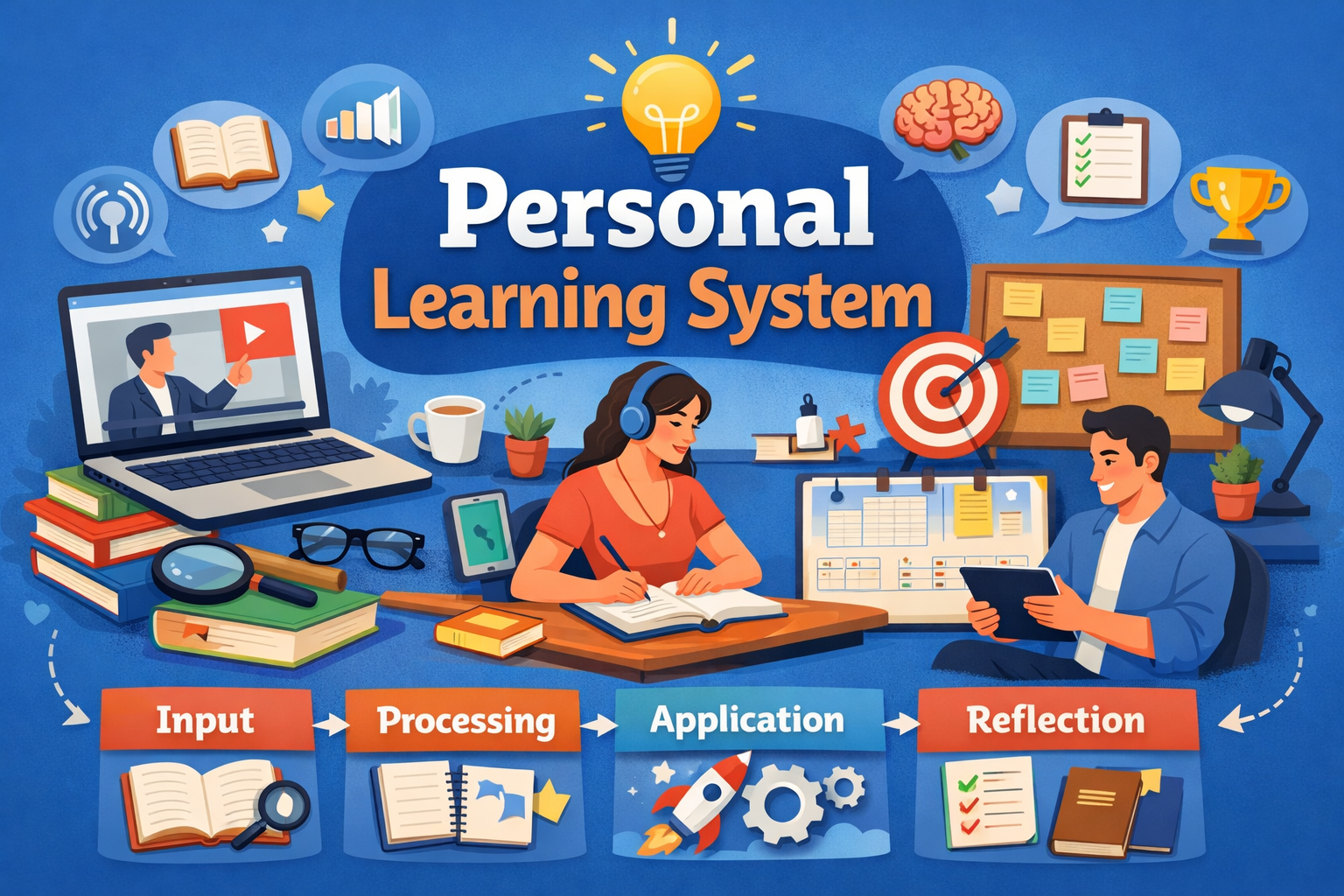
Learning today is no longer limited to classrooms, degrees, or formal certifications. In the digital age, the most successful people are those who know how to design their own learning processes. Instead of relying on external structures, they create a system — a repeatable, flexible framework that helps them grow continuously without burnout.
This article will guide you step by step on how to build a personal learning system that works for your lifestyle, goals, and cognitive strengths.
Why You Need a Personal Learning System
Many people start learning with enthusiasm but quit halfway. The problem is rarely motivation — it’s the absence of structure.
A personal learning system:
- Reduces overwhelm
- Prevents information overload
- Makes progress measurable
- Encourages consistency
- Minimizes burnout
Without a system, learning becomes random. You jump from YouTube videos to blog posts to online courses without integration. With a system, every input has a purpose.
Step 1: Define Clear Learning Outcomes
Before selecting tools, courses, or schedules, you must define why you’re learning.
Ask yourself:
- What skill do I want to master?
- Why does this matter to me?
- What does success look like in 3–6 months?
Avoid vague goals like “learn marketing.” Instead, define something specific such as:
- Build and launch a landing page
- Write persuasive email sequences
- Analyze customer data effectively
Clarity reduces cognitive noise.
Step 2: Design Your Learning Framework
A personal learning system works best when it has structure. One simple model you can follow:
1. Input
Where information comes from (books, courses, podcasts, mentors).
2. Processing
Note-taking, summarizing, mind-mapping, or rewriting concepts.
3. Application
Practice, projects, experiments.
4. Reflection
Reviewing what worked, what didn’t, and adjusting.
This cycle ensures learning is active — not passive consumption.
If you’re looking for deeper foundational strategies, you may want to explore resources like The Complete Guide to Self-Learning, which explains how independent learners can structure long-term growth effectively.
Step 3: Choose the Right Learning Tools
Tools should support your system — not distract you.
You may use:
- A digital note-taking app (Notion, Obsidian, Evernote)
- A spaced repetition system (Anki)
- A task manager (Todoist, Trello)
- A simple journal
The key is integration. Your notes, tasks, and goals should connect logically.
Avoid overcomplicating your setup. A simple Google Docs + calendar system can work if used consistently.
Step 4: Build a Weekly Learning Routine
Consistency beats intensity.
Instead of studying 5 hours once a week, aim for:
- 30–60 minutes daily
- Scheduled time blocks
- Defined topics per session
Example weekly structure:
Monday: Theory and concepts
Tuesday: Practice exercises
Wednesday: Case studies
Thursday: Project work
Friday: Review and reflection
This repetition builds neural pathways gradually and sustainably.
Step 5: Use Active Learning Techniques
Passive learning (watching, highlighting, rereading) creates illusion of progress. Active learning builds mastery.
Examples:
- Teach the concept aloud (Feynman Technique)
- Build mini-projects
- Write summaries without looking at notes
- Create flashcards
- Join discussion communities
Adults especially benefit from active engagement. If your goal includes improving cognitive efficiency, understanding strategies from How to Learn Faster as an Adult can significantly improve retention and speed.
Step 6: Create a Knowledge Management System
Learning doesn’t end when you finish a course. You must store and organize knowledge for future retrieval.
A good knowledge management system:
- Categorizes ideas clearly
- Links related concepts
- Allows quick searching
- Encourages updating
For example:
Instead of saving random bookmarks, extract key ideas and rewrite them in your own words. Your notes should become a personal knowledge library.
Think long-term. What you learn today should still be usable 2–3 years from now.
Step 7: Apply the 70-20-10 Rule
Many professionals use the 70-20-10 model:
- 70% Learning by doing
- 20% Learning from others
- 10% Formal study
Your personal learning system should emphasize action.
If you’re learning coding, build apps.
If you’re learning writing, publish articles.
If you’re learning business, test micro-projects.
Application transforms information into skill.
Step 8: Track Progress and Adjust
A learning system must evolve.
Every month, ask:
- What worked well?
- Where did I struggle?
- Did I stay consistent?
- What should I simplify?
Tracking methods:
- Habit trackers
- Weekly reflection notes
- Skill milestone checklists
- Portfolio creation
Visible progress builds motivation.
Step 9: Prevent Burnout
Burnout usually happens when:
- Goals are unrealistic
- Schedules are overloaded
- Perfectionism dominates
- Rest is ignored
To prevent burnout:
- Schedule rest days
- Use the 50–10 rule (50 minutes study, 10 minutes break)
- Stop before exhaustion
- Focus on long-term sustainability
Remember: A personal learning system is a marathon structure, not a sprint strategy.
Step 10: Turn Learning Into Identity
The strongest systems are identity-based.
Instead of saying:
“I’m trying to learn.”
Say:
“I am someone who learns every day.”
When learning becomes part of your identity, consistency becomes natural.
Sample Personal Learning System Blueprint
Here’s a simple template you can follow:
Goal: Become proficient in digital marketing within 6 months
Daily Routine:
- 45 minutes study
- 30 minutes practice
Tools:
- Notion for notes
- Google Calendar for scheduling
- Trello for project tracking
Weekly Review:
- Every Sunday evening
- Adjust schedule if needed
Monthly Output:
- Publish 1 blog post
- Run 1 marketing experiment
This makes learning concrete and measurable.
Final Thoughts
Building a personal learning system is not about copying someone else’s method. It’s about designing a framework that fits your goals, lifestyle, and energy levels.
When structured properly, your system will:
- Reduce overwhelm
- Increase retention
- Improve skill mastery
- Prevent burnout
- Support lifelong growth
In a world where information is unlimited, your advantage is not access — it’s organization and execution.
Create your system. Refine it. Trust it. And most importantly, use it consistently.
Because real growth doesn’t come from consuming more — it comes from learning with intention.