Active Learning Techniques That Work
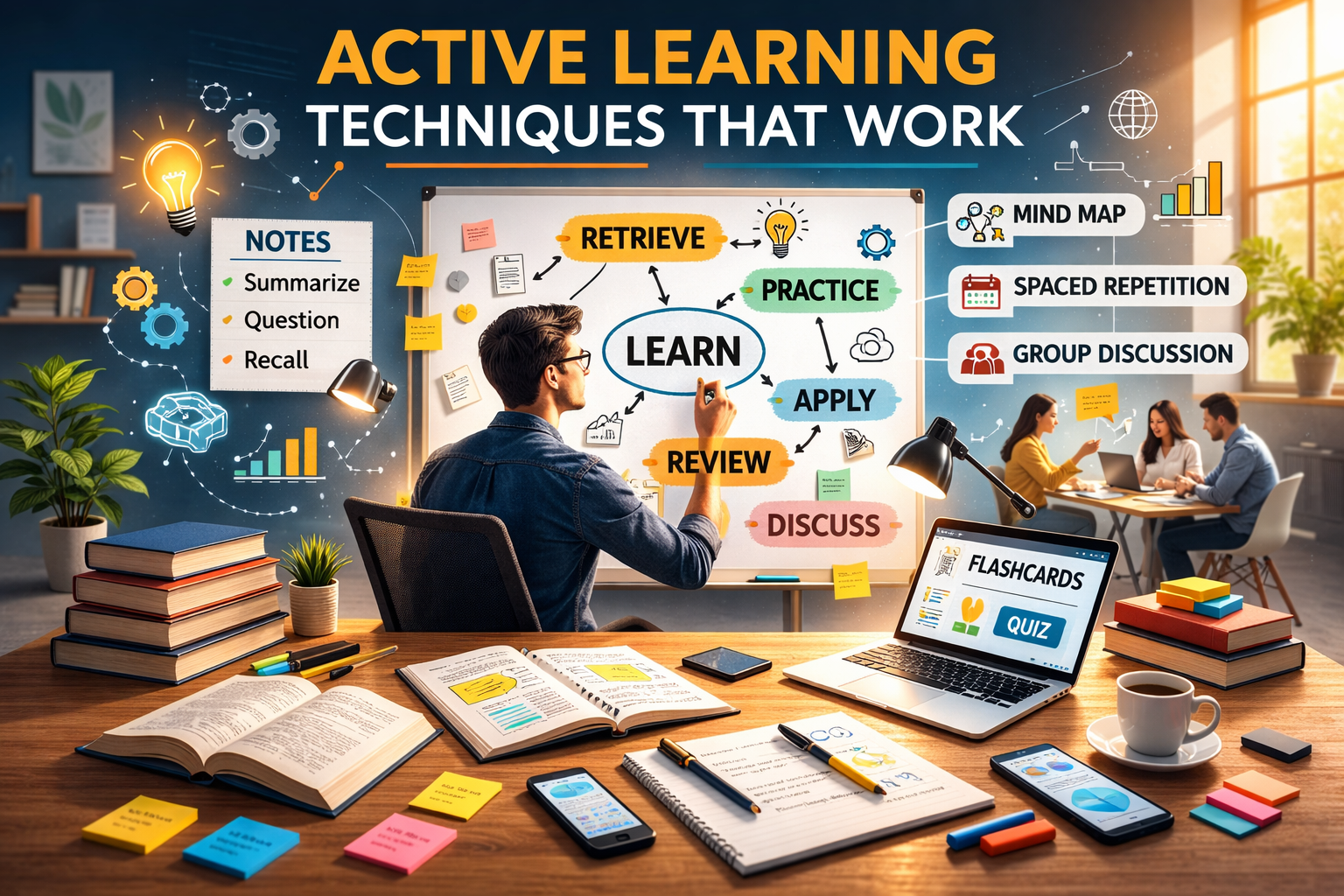
In a world overflowing with information, passive learning is no longer enough. Simply reading, listening, or watching without engagement often leads to shallow understanding and quick forgetting. If you truly want to improve retention, comprehension, and skill development, active learning is the key.
Active learning techniques that work are not about studying harder — they’re about studying smarter. Instead of being a passive consumer of information, you become an active participant in the learning process.
In this guide, we’ll explore powerful, research-backed active learning strategies that you can start using immediately.
What Is Active Learning?
Active learning is a method of learning that requires meaningful engagement with material. Instead of just absorbing information, you interact with it — questioning, analyzing, discussing, applying, and reflecting.
Passive learning:
- Reading without notes
- Listening without reflection
- Highlighting without thinking
Active learning:
- Teaching the material to someone else
- Solving real problems
- Asking critical questions
- Practicing retrieval
- Applying concepts to new situations
The difference lies in cognitive effort. The more your brain works with the information, the stronger the memory pathways become.
Why Active Learning Works
Active learning is effective because it aligns with how the brain naturally processes information.
1. Retrieval Strengthens Memory
When you actively recall information, you strengthen neural connections. This is known as retrieval practice — one of the most powerful learning techniques supported by cognitive science.
2. Deeper Processing Improves Understanding
Explaining concepts in your own words forces your brain to reorganize information, making it easier to understand and remember.
3. Immediate Feedback Accelerates Growth
Active learning often includes testing, discussion, or practice — which helps you quickly identify mistakes and correct them.
If you want to explore broader strategies for accelerated improvement, you may also enjoy reading How to Learn Faster as an Adult, which expands on brain-based techniques for skill development.
Proven Active Learning Techniques That Work
Below are practical techniques you can apply today.
1. The Feynman Technique
Named after physicist Richard Feynman, this method involves:
- Choose a concept.
- Explain it in simple language as if teaching a beginner.
- Identify gaps in your explanation.
- Review and simplify further.
If you cannot explain something simply, you don’t understand it deeply enough.
Why it works:
- Forces clarity
- Reveals knowledge gaps
- Encourages deep processing
2. Retrieval Practice (Active Recall)
Instead of rereading notes, close the book and try to recall what you learned.
Examples:
- Write down everything you remember from memory.
- Answer practice questions.
- Use flashcards.
- Teach without looking at notes.
This strengthens long-term retention far more than passive review.
3. Spaced Repetition
Rather than cramming, review material at increasing intervals:
- Day 1
- Day 3
- Day 7
- Day 14
Spacing forces your brain to reconstruct information, making memory more durable.
4. Practice by Doing (Deliberate Practice)
Skill-based learning requires application. Reading about coding, writing, or public speaking is not enough — you must practice.
Effective practice includes:
- Focused sessions
- Immediate feedback
- Targeting weaknesses
- Repetition with refinement
This approach builds competence faster than passive exposure.
5. Interleaving
Instead of studying one topic for hours, mix related subjects.
For example:
- Study math topic A
- Switch to topic B
- Return to topic A
This forces your brain to differentiate between concepts, improving long-term understanding.
6. Question-Driven Learning
Before reading a chapter, ask:
- What problem does this solve?
- Why does this matter?
- How can I apply this?
Questions activate curiosity and prime the brain for learning.
7. Discussion and Collaboration
Explaining ideas to others reveals misunderstandings and strengthens comprehension.
Group discussion helps because:
- You hear alternative perspectives
- You articulate your reasoning
- You defend your ideas
Social learning increases engagement and retention.
8. Mind Mapping
Create a visual map connecting concepts.
Start with a central idea, then branch out into:
- Subtopics
- Examples
- Relationships
- Applications
Visual structuring improves organization and understanding.
9. Real-World Application
Learning becomes powerful when connected to reality.
Instead of:
- Memorizing business theory
Try:
- Analyzing a real company
- Building a small project
- Testing ideas experimentally
This bridges theory and practice.
You can see how digital platforms support this shift in modern education in How Technology Is Changing the Way We Learn, which highlights how interactive tools make active engagement easier than ever.
How to Build an Active Learning Routine
Here’s a simple framework:
Step 1: Preview
Skim the material and generate questions.
Step 2: Learn Actively
Use:
- Feynman technique
- Retrieval practice
- Note summarization
Step 3: Apply
Do exercises or real-world practice.
Step 4: Review with Spacing
Revisit after increasing time intervals.
Step 5: Reflect
Ask:
- What did I misunderstand?
- What felt difficult?
- How can I improve next time?
Reflection converts experience into insight.
Common Mistakes to Avoid
1. Over-Highlighting
Highlighting feels productive but rarely improves retention.
2. Rereading Excessively
Familiarity is not mastery.
3. Multitasking
Attention switching reduces cognitive depth.
4. Avoiding Struggle
Desirable difficulty improves learning. If it feels slightly hard, you’re doing it right.
Active Learning for Different Goals
For Students
- Practice retrieval daily
- Use spaced repetition
- Teach classmates
For Professionals
- Apply knowledge immediately
- Use case studies
- Seek feedback
For Skill Learners
- Practice deliberately
- Record performance
- Analyze mistakes
Active learning adapts to any field — academic, professional, or creative.
The Science Behind Engagement
Cognitive research consistently shows that learning improves when learners:
- Retrieve information
- Generate answers
- Elaborate explanations
- Practice in varied contexts
The brain strengthens neural pathways through active reconstruction, not passive exposure.
The more effortful the recall (within reason), the stronger the memory.
Final Thoughts
Active learning techniques that work are built on one simple principle: engagement creates understanding.
If you want better retention, faster skill growth, and deeper comprehension, shift from consuming information to interacting with it.
Instead of asking:
“How much did I read?”
Ask:
“How much did I actively process, apply, and retrieve?”
The difference between knowing and mastering often lies in how actively you learn.