High-Value Skills in the Digital Age
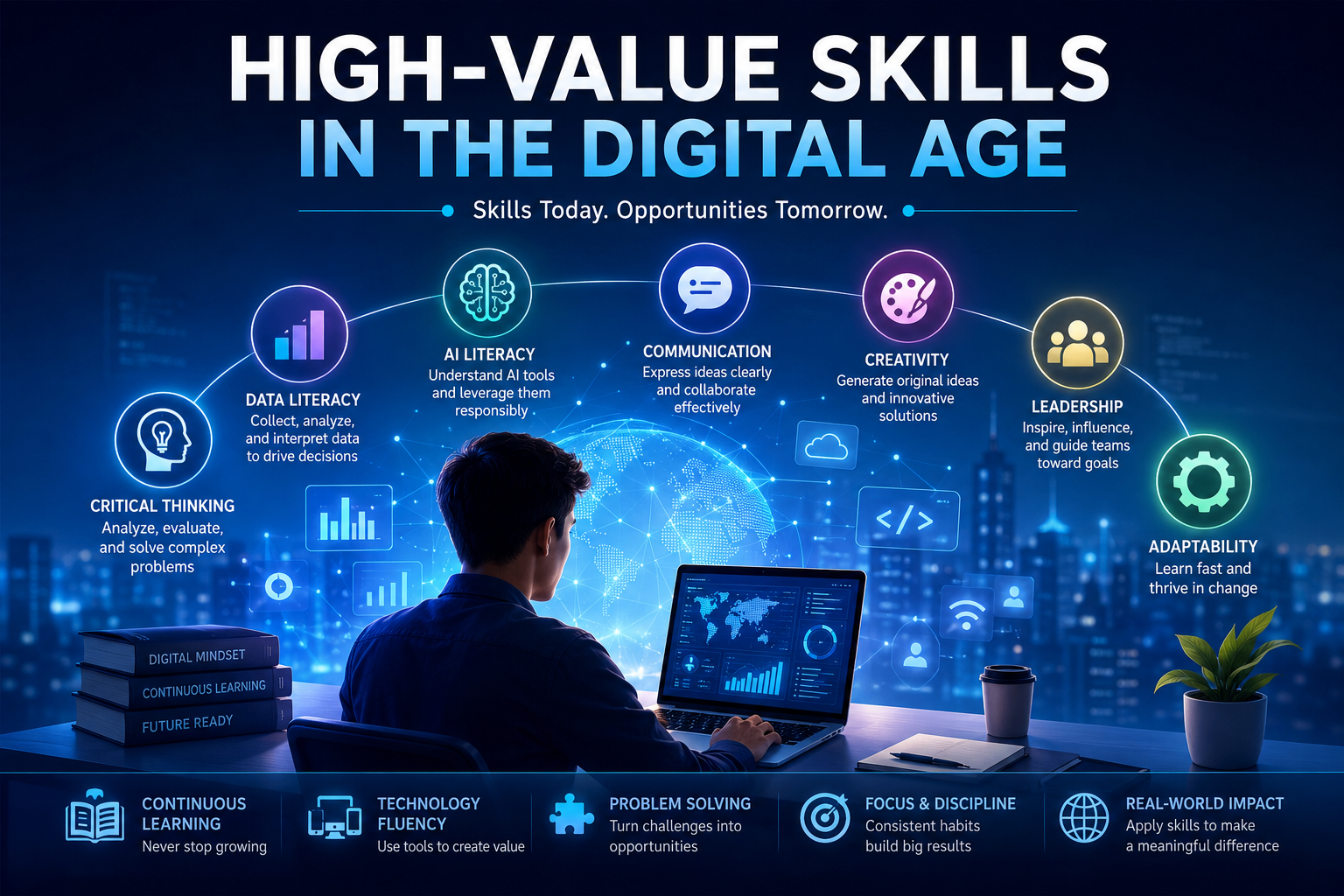
The digital revolution has transformed how people work, communicate, and build successful careers. Skills that were once considered optional have become essential, while traditional knowledge alone is no longer enough to stay competitive. Whether you are a student, freelancer, entrepreneur, or corporate professional, understanding which abilities create the most value can significantly improve your opportunities.
The modern economy rewards individuals who continuously adapt, solve complex problems, and leverage technology effectively. Instead of relying on a single qualification earned years ago, successful professionals embrace lifelong learning and continuously update their expertise.
This guide explores the most valuable skills in today’s digital landscape, why they matter, and practical strategies to develop them.
Understanding High-Value Skills
High-value skills are abilities that:
- Solve meaningful problems
- Are difficult to automate
- Increase productivity
- Generate measurable business results
- Remain relevant across multiple industries
Unlike routine tasks, these skills combine technical knowledge with creativity, communication, and strategic thinking.
Examples include:
- Data analysis
- Digital marketing
- Programming
- Artificial intelligence literacy
- Content creation
- Project management
- UX/UI design
- Critical thinking
- Leadership
- Problem-solving
Professionals who combine multiple complementary skills often become significantly more valuable than specialists who focus on only one area.
Why Digital Skills Matter More Than Ever
Technology continues to reshape every industry.
Healthcare uses AI-assisted diagnostics.
Education relies on online learning platforms.
Retail depends on e-commerce and digital advertising.
Finance embraces automation and data analytics.
Manufacturing integrates smart systems and robotics.
This widespread digital transformation means employees and entrepreneurs who understand technology can adapt more quickly to change.
Rather than replacing humans entirely, technology increasingly rewards people who know how to work alongside it.
The Most Valuable Digital Skills Today
1. Data Literacy
Every organization generates enormous amounts of information.
People who can collect, interpret, and communicate insights from data help businesses make smarter decisions.
Key competencies include:
- Reading dashboards
- Understanding metrics
- Creating reports
- Finding trends
- Making evidence-based recommendations
Data literacy is useful for marketers, managers, teachers, developers, and entrepreneurs alike.
2. Artificial Intelligence Literacy
AI tools are becoming part of everyday work.
Knowing how AI functions—and where its strengths and limitations lie—helps professionals improve productivity without sacrificing quality.
Important AI skills include:
- Writing effective prompts
- Evaluating AI-generated content
- Fact-checking outputs
- Automating repetitive tasks
- Combining human creativity with machine efficiency
People who understand AI are better prepared for the future workplace.
3. Digital Communication
Communication has expanded far beyond face-to-face conversations.
Modern professionals regularly communicate through:
- Video meetings
- Collaboration platforms
- Social media
- Online communities
Strong digital communication requires clarity, empathy, organization, and adaptability.
The ability to explain complex ideas simply is increasingly valuable.
4. Critical Thinking
Information is everywhere, but not all information is accurate.
Critical thinkers evaluate evidence before making decisions.
They ask:
- Is this source reliable?
- What assumptions are being made?
- What evidence supports this claim?
- Are there alternative explanations?
This ability reduces mistakes and improves problem-solving in every profession.
5. Creativity
Automation handles repetitive work, but creativity remains uniquely human.
Creative professionals:
- Generate original ideas
- Connect unrelated concepts
- Design innovative solutions
- Adapt quickly to changing circumstances
Creativity supports fields ranging from software development to marketing and education.
Adaptability: The Ultimate Career Skill
Technology changes rapidly.
Programming languages evolve.
Marketing strategies shift.
AI capabilities improve.
Industries transform.
People who resist change often struggle to remain competitive.
Adaptable professionals:
- Learn continuously
- Accept feedback
- Experiment with new tools
- Stay curious
- Embrace challenges
Adaptability turns uncertainty into opportunity.
Building a Continuous Learning Mindset
Learning is no longer something that ends after graduation.
Successful professionals treat education as an ongoing process.
They:
- Read regularly
- Watch tutorials
- Practice new skills
- Join communities
- Build personal projects
- Reflect on mistakes
Small daily improvements compound into significant long-term growth.
One practical resource that complements this philosophy is How to Learn New Skills Quickly, which emphasizes structured practice, deliberate repetition, and immediate application rather than passive consumption of information.
The Importance of Digital Collaboration
Modern projects rarely involve working alone.
Teams often span multiple cities or even countries.
Successful collaboration requires:
Clear Communication
Everyone should understand goals, deadlines, and responsibilities.
Documentation
Well-organized documentation reduces confusion and preserves knowledge.
Accountability
Reliable professionals consistently deliver quality work on time.
Feedback
Constructive feedback helps teams improve without creating conflict.
People who collaborate effectively become trusted contributors and future leaders.
Problem-Solving in the Digital Economy
Employers increasingly value people who solve problems rather than simply complete assigned tasks.
Effective problem-solving follows a structured process:
Identify the real issue
Avoid solving symptoms instead of root causes.
Gather information
Collect relevant data before making assumptions.
Generate multiple solutions
Consider several approaches instead of choosing the first idea.
Evaluate outcomes
Measure results and continuously improve the solution.
This systematic thinking creates long-term value for organizations.
Technical Skills vs. Human Skills
Many people focus exclusively on technical knowledge.
However, the highest-performing professionals combine technical expertise with interpersonal abilities.
| Technical Skills | Human Skills |
|---|---|
| Programming | Leadership |
| Data Analysis | Communication |
| AI Tools | Empathy |
| Automation | Collaboration |
| Digital Marketing | Critical Thinking |
| Cybersecurity | Adaptability |
The combination creates professionals who can both build solutions and inspire people.
Time Management in a Distracted World
Digital devices provide incredible opportunities but also endless distractions.
Improving focus requires intentional habits:
- Turn off unnecessary notifications
- Schedule deep work sessions
- Prioritize important tasks
- Limit multitasking
- Review progress daily
Many learners also improve productivity by using Best Tech Tools for Learning and Focus, which help organize information, reduce distractions, and maintain consistent study routines without overwhelming users.
Creating a Personal Skill Development Plan
Developing valuable skills becomes easier with a structured approach.
Step 1: Assess Current Abilities
Identify strengths and weaknesses honestly.
Step 2: Set Specific Goals
Instead of saying:
“I want to improve technology skills.”
Define:
“I will complete three Python projects within two months.”
Step 3: Practice Consistently
Small daily sessions outperform occasional intensive study.
Step 4: Build Real Projects
Applying knowledge reinforces learning better than memorization alone.
Step 5: Review Progress
Regular reflection identifies what works and what needs adjustment.
The Future of High-Value Skills
Several trends will continue shaping the workforce:
Artificial Intelligence Integration
AI will become a standard productivity tool across industries.
Remote Collaboration
Global teams will become increasingly common.
Data-Driven Decision Making
Organizations will rely even more heavily on analytics.
Lifelong Learning
Continuous education will become a normal part of every career.
Human-Centered Skills
Creativity, empathy, leadership, and strategic thinking will become even more valuable as automation expands.
Professionals who combine technological literacy with uniquely human capabilities will remain highly competitive.
Conclusion
High-value skills in the digital age extend far beyond technical expertise. The most successful individuals combine digital literacy, critical thinking, creativity, communication, adaptability, and continuous learning into a versatile skill set that evolves alongside technology.
Rather than chasing every new trend, focus on building strong foundational abilities and consistently improving them through practice and real-world application. Over time, these investments create a powerful competitive advantage, opening doors to better careers, stronger businesses, and lifelong professional growth in an increasingly digital world.