How to Learn Independently Without Burnout
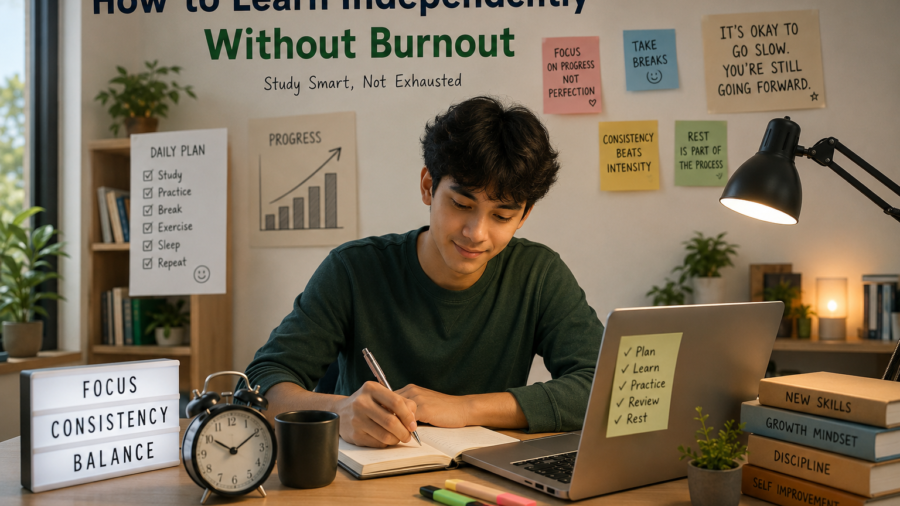
In an era where knowledge is available at our fingertips, learning independently has become more accessible than ever. Whether you’re mastering programming, improving your writing skills, learning a foreign language, or preparing for a professional certification, self-directed learning offers flexibility that traditional education often cannot match.
However, there is a hidden challenge that many independent learners face: burnout. The excitement of starting a new learning journey can quickly turn into exhaustion, frustration, and even complete loss of motivation. Many people mistakenly believe that studying longer hours always leads to better results, but sustainable learning depends much more on consistency than intensity.
This guide explores practical strategies for learning independently while maintaining your energy, motivation, and mental well-being. By building healthy learning habits, setting realistic goals, and managing your workload effectively, you can continue improving your skills for years without sacrificing your health.
Why Independent Learning Often Leads to Burnout
Self-learning places all responsibility on the learner. Without teachers, fixed schedules, or classmates to provide accountability, it becomes easy to overwork yourself.
Some common reasons include:
- Setting unrealistic expectations.
- Trying to learn too many subjects simultaneously.
- Comparing your progress with experts.
- Ignoring physical and mental fatigue.
- Feeling guilty whenever you’re not studying.
Ironically, these behaviors reduce learning efficiency. As mental fatigue increases, concentration decreases, making every study session less productive.
Burnout rarely happens overnight. It develops gradually through continuous stress combined with insufficient recovery.
Understanding the Difference Between Hard Work and Healthy Learning
Working hard is valuable, but productive learning requires balance.
Healthy learners recognize that the brain functions similarly to muscles. After intense effort, it requires recovery to consolidate information and prepare for future learning.
Studying for ten focused hours one day followed by complete exhaustion for three days is generally less effective than studying two focused hours every day for several months.
Consistency almost always beats intensity.
Set Learning Goals That Are Actually Achievable
Many learners fail because their goals are far too ambitious.
Instead of saying:
“I’ll master Python this month.”
Try:
“I’ll complete one lesson every weekday.”
Smaller goals provide several benefits:
- Higher completion rates.
- Increased motivation.
- Clear measurement of progress.
- Less pressure.
- Greater long-term consistency.
Daily wins create positive momentum that encourages continuous learning.
Build a Sustainable Study Routine
A predictable routine removes the need to constantly decide when to study.
Instead of relying on motivation, create habits.
A sustainable routine might include:
- Study at the same time each day.
- Use a dedicated study environment.
- Remove unnecessary distractions.
- Prepare learning materials beforehand.
- Finish with a quick review.
The goal is making studying automatic rather than emotionally driven.
Learn One Major Skill at a Time
Many independent learners attempt to learn everything simultaneously.
For example:
- Programming
- Graphic design
- Video editing
- Marketing
- Data science
- Public speaking
While curiosity is wonderful, dividing attention across numerous difficult subjects slows progress significantly.
Choose one primary learning objective while keeping other interests as secondary hobbies.
Depth usually produces better results than constant switching.
Avoid Information Overload
The internet provides endless tutorials, books, podcasts, and online courses.
Ironically, too many resources often prevent actual learning.
Instead of collecting courses, commit to finishing one before purchasing another.
A simple learning workflow could be:
- Choose one trusted course.
- Finish every lesson.
- Practice consistently.
- Review mistakes.
- Only then move to advanced material.
Progress comes from implementation rather than endless consumption.
Focus on Active Learning
Reading and watching videos feel productive, but they are only the beginning.
Real learning occurs when you actively engage with the material.
Examples include:
- Solving exercises.
- Building projects.
- Teaching others.
- Taking notes in your own words.
- Explaining concepts from memory.
Active learning strengthens understanding and improves long-term retention.
Schedule Regular Breaks
Many people feel guilty about taking breaks.
In reality, breaks are part of effective learning.
The brain consolidates information during periods of rest.
Consider techniques such as:
- 25 minutes study, 5 minutes rest.
- 50 minutes study, 10 minutes rest.
- Longer breaks every few hours.
During breaks:
- Stretch.
- Walk around.
- Drink water.
- Avoid endless social media scrolling.
Refreshing your mind improves concentration for the next session.
Protect Your Physical Health
Independent learning often involves long hours sitting at a desk.
Ignoring physical health eventually harms mental performance.
Maintain healthy habits such as:
- Getting enough sleep.
- Staying hydrated.
- Exercising regularly.
- Maintaining good posture.
- Taking eye breaks.
Your brain performs best when your body is well cared for.
Accept That Progress Isn’t Linear
Some weeks you’ll learn rapidly.
Other weeks you may struggle with concepts that seem impossible.
This is completely normal.
Learning naturally involves:
- Plateaus.
- Temporary confusion.
- Mistakes.
- Revision.
- Breakthrough moments.
Temporary slowdowns do not mean you’re failing.
They are simply part of mastering complex skills.
Stop Comparing Yourself to Others
Social media often showcases finished success rather than the difficult learning journey.
You may see:
- Professional developers.
- Fluent language speakers.
- Successful entrepreneurs.
- Published authors.
What you don’t see are the years of practice behind those achievements.
Compare yourself only with your previous version.
Personal improvement is a much healthier benchmark than competing with strangers.
Use Reflection to Improve Faster
Learning becomes much more effective when combined with regular reflection.
At the end of each week, ask yourself:
- What did I learn?
- What confused me?
- What distracted me?
- What worked well?
- What should I improve next week?
Reflection transforms experience into continuous improvement.
Create a Personalized Learning System
No single learning method works for everyone.
Experiment with:
- Digital notes.
- Handwritten notebooks.
- Flashcards.
- Mind maps.
- Project-based learning.
- Video lessons.
- Books.
Over time you’ll discover which combination fits your learning style best.
For those beginning their self-education journey, The Complete Guide to Self-Learning provides an excellent framework for organizing study plans, selecting resources, and maintaining long-term progress without becoming overwhelmed.
Know When to Slow Down
Taking a slower pace does not mean giving up.
Warning signs that you need recovery include:
- Constant exhaustion.
- Difficulty concentrating.
- Loss of motivation.
- Irritability.
- Poor sleep.
- Feeling anxious before studying.
Instead of quitting completely, reduce your workload temporarily.
Sometimes studying less actually leads to learning more.
Celebrate Small Milestones
Many learners only celebrate major achievements.
Instead, recognize progress like:
- Completing a chapter.
- Finishing a project.
- Solving a difficult problem.
- Studying consistently for a week.
- Maintaining your schedule.
Small celebrations reinforce positive habits and maintain motivation.
Develop Long-Term Thinking
Independent learning is not a race.
The most successful learners often spend years steadily improving.
Rather than asking:
“How much can I learn this week?”
Ask:
“What habits will help me keep learning five years from now?”
Long-term consistency produces extraordinary results.
Build Recovery Into Your Learning Plan
Recovery should be scheduled rather than treated as an emergency response.
Ideas include:
- One lighter study day each week.
- Monthly review sessions instead of new material.
- Short vacations from intensive learning.
- Hobby time unrelated to your primary skill.
Recovery prevents burnout before it starts.
Learn to Enjoy the Process
Many learners focus only on the destination.
They constantly think about:
- Getting a certificate.
- Landing a new job.
- Passing an exam.
- Earning more money.
While goals are important, lasting motivation comes from enjoying daily improvement itself.
Curiosity is a stronger fuel than pressure.
Create Healthy Boundaries
Independent learning can easily consume all your free time.
Set boundaries such as:
- No studying late at night.
- Protect weekends occasionally.
- Maintain relationships.
- Continue exercising.
- Make time for hobbies.
A balanced life supports sustainable learning.
Recognize That Rest Is Productive
Rest is not wasted time.
Quality sleep strengthens memory.
Exercise improves cognitive function.
Relaxation reduces stress.
Social interaction supports emotional health.
All of these contribute directly to better learning performance.
Treat recovery as an essential component of education rather than a reward.
Conclusion
Learning independently is one of the most valuable investments you can make in yourself, but success depends on sustainability rather than relentless effort. Burnout is not a sign of weakness—it is often the result of unrealistic expectations, poor recovery, and an imbalanced routine. By setting achievable goals, focusing on consistent progress, taking meaningful breaks, and protecting both your physical and mental well-being, you can continue learning effectively for years to come.
Remember that independent learning is a marathon, not a sprint. Every small study session, completed project, and lesson learned contributes to your long-term growth. If you’re looking for additional practical strategies to maintain balance while studying, How to Study Without Burnout offers valuable insights into building healthier study habits and staying motivated without sacrificing your well-being. Ultimately, the learners who achieve the greatest success are not those who study the hardest, but those who build habits they can sustain for a lifetime.